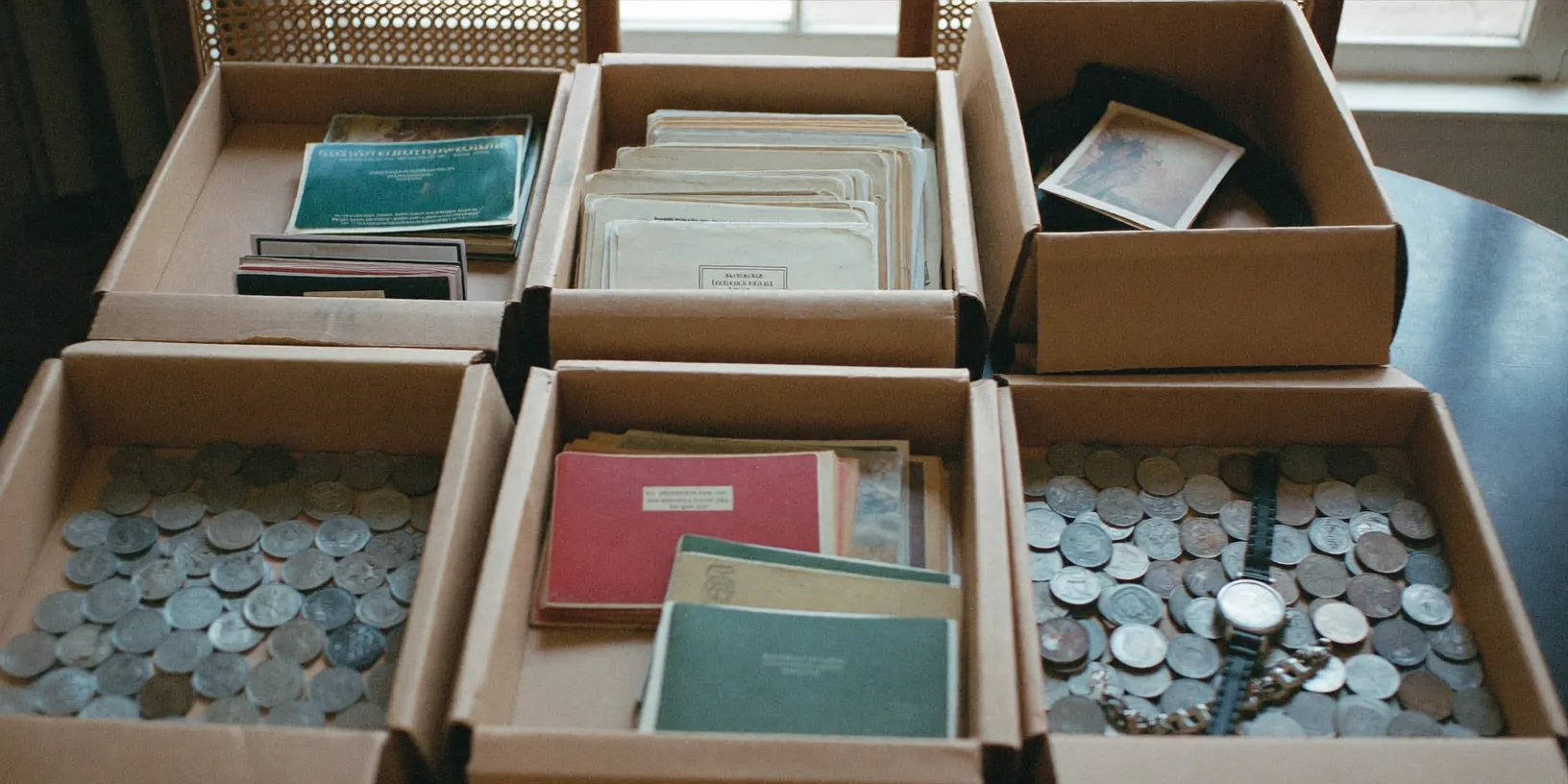
Inheriting a collection is two hard problems arriving at once. There's the practical one: boxes of objects you may know nothing about, in quantities you didn't ask for, that are suddenly your responsibility. And there's the emotional one: these were someone's treasures, assembled over decades, and every decision about them feels like a decision about the person.
The mistake almost everyone makes is trying to solve everything in one heroic weekend — identify it all, value it all, decide it all. That path leads to overwhelm, and overwhelm leads to the two classic bad outcomes: the collection sits untouched in a garage for a decade, or it gets sold in bulk to the first dealer who makes an offer. There is a better way, and it works in passes.
Pass one: stabilize, and deliberately don't sort
Your first job is protective, not organizational. Get everything out of the danger zones — damp basements, hot attics, direct sunlight, anywhere with big temperature swings. Ordinary living space is fine; a spare closet beats a climate-controlled unit you're paying for in a panic.
Resist the urge to clean anything. This is counterintuitive and vital: cleaning destroys value across a remarkable range of categories. Polished coins lose most of their collector premium. Washed toys lose original paint. Wiped wooden items lose patina that took a century to form. Until you know which items care, treat them all as if they do.
And keep boxes together as found. The way a collector grouped things is information — that shoebox holds those particular cards for a reason you don't understand yet. Resorting everything on day one erases the last organizational thoughts of the person who built the collection.
Pass two: rough triage into three piles
Now walk through the boxes making fast, low-stakes calls. You're building three piles: obviously significant, obviously ordinary, and unknown.
Obviously significant announces itself: anything slabbed or cased, anything with certificates or receipts, anything the collector stored with visible extra care, anything you already know is good. Obviously ordinary is the loose duplicates, the damaged mass-market items, the common material every collection accumulates. Everything else — and there will be a lot of it — is unknown, and that's fine. Most inherited collections run roughly ten percent significant, sixty percent ordinary, and thirty percent unknown, and the unknowns are where the surprises live in both directions.
Don't research during triage. The moment you stop to look something up, a two-hour pass becomes a two-month stall.
Pass three: catalog the significant pile properly
Here's where the real work starts, and where it pays to work item by item. Photograph each significant piece — a clear overall shot and any marks, labels, or signatures — and record everything you know: where it was kept, what was stored with it, any paperwork found nearby, and every scrap of family story attached to it.
That last part is urgent in a way the objects themselves aren't. Provenance that isn't written down evaporates. The uncle who remembers where the clock came from won't remember forever; the receipt tucked in the case means nothing once separated from the case. Capture the stories now, verbatim, labeled as family memory — this is exactly what a private catalog is built for, one item, one photo, one story at a time.
Pass four: work the unknowns at a sustainable pace
The unknown pile is a research project, so treat it like one: a few items per week, not a crusade. Photograph each piece and get identifications. AI identification gives you a fast first pass on category and era, and collector communities are remarkably generous with "what is this?" questions — a clear photo posted to people who love the category often gets an answer in hours, with reasoning attached.
As identifications come in, items graduate: into the significant pile for real cataloging, or into the ordinary pile with your conscience clear. Expect a handful of shocks. Every experienced appraiser has a story about the valuable item that spent years in the "probably nothing" box.
The three rules that protect inheritors
Sell nothing in the first month. Early sales are where inheritors get hurt, because grief plus unfamiliarity is exactly the state a lowball offer is designed for. The collection waited years; it can wait thirty days.
Never let a single dealer price the whole collection in one visit. Any blanket offer for unsorted boxes is priced on the assumption you don't know what's in them — and if you've read this far, you soon will. Get category specialists for the significant material, and get more than one opinion on anything substantial.
Throw away nothing that looks like paper. Boxes, manuals, receipts, letters, even old price tags — original packaging and documentation carry real value, and the letter tucked in a book can matter more than the book.
Grief has no deadline, and neither does this. A collection that took decades to build deserves more than a weekend of decisions — and worked through in passes, it becomes something manageable: not a burden, but a last long conversation with the person who built it.