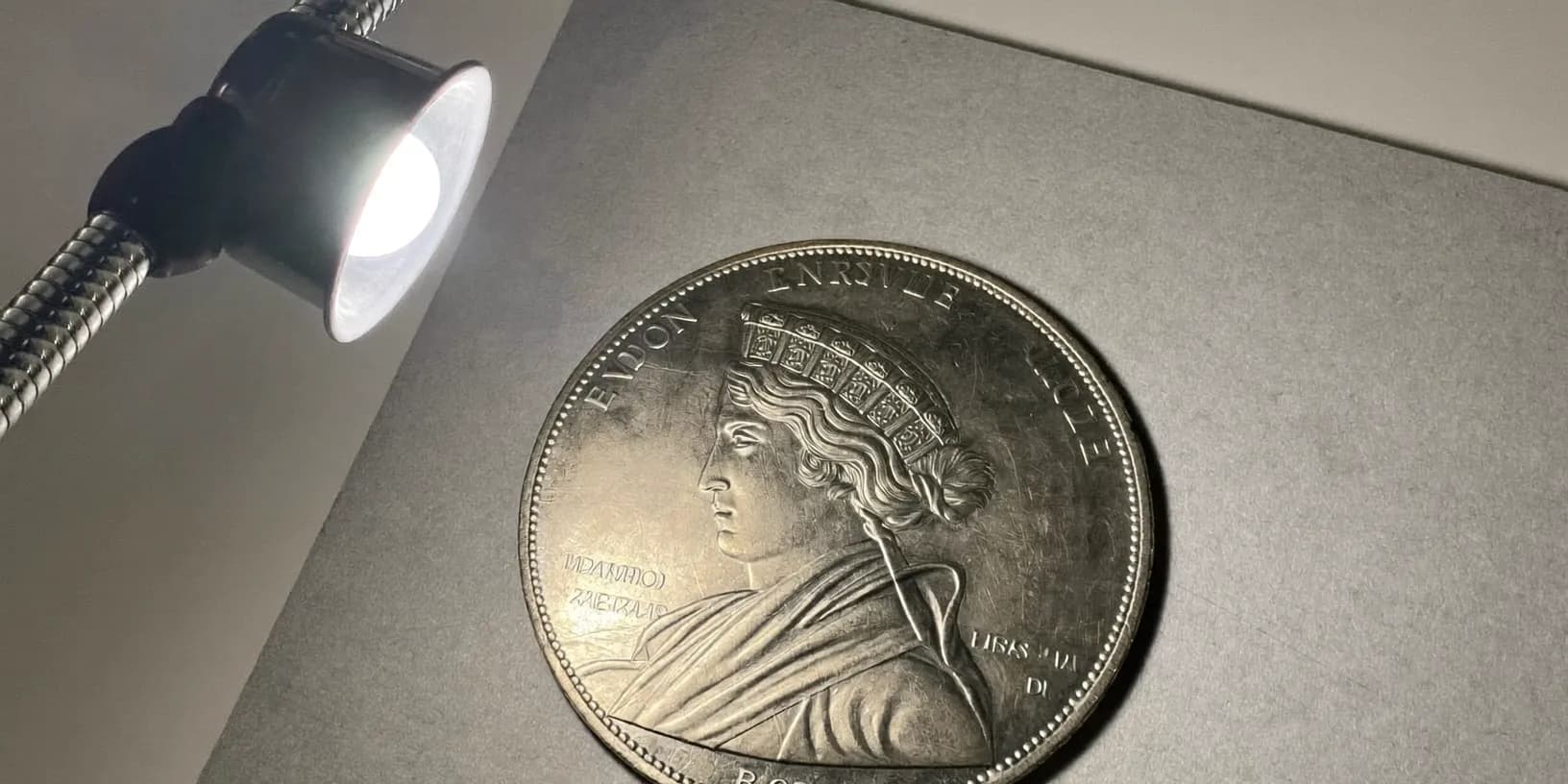
A coin is the hardest ordinary object you will ever photograph. It's small, it's shiny, its most valuable qualities — luster, strike, surface originality — are visible only at certain angles of light, and every flaw in your technique shows up doubled because the coin mirrors your mistakes back at the lens. The good news: the collectors producing stunning coin photography are overwhelmingly using phone cameras and desk lamps. The difference is technique, and the technique is learnable in an afternoon.
Everything that follows assumes the simplest possible kit: a phone, one lamp, something white to soften it, and a piece of grey card. If you have those, you have a coin studio.
Light placement decides everything
A coin's field is effectively a mirror, so the camera records whatever the coin reflects. Overhead room lights sit almost directly above a coin lying flat — which means they reflect almost directly into a camera positioned above it, producing the washed-out hotspot that ruins most amateur coin photos. So the first move is always the same: turn off the overheads and work with one light you control.
Place that light high and off to the side — around ten o'clock or two o'clock relative to the coin — and soften it by aiming it through a white cloth or bouncing it off white card. Soft, angled light wraps around the relief, throws gentle shadows that make the design read as three-dimensional, and keeps the light source itself out of the mirror.
The camera goes directly overhead, square to the coin. Keep it square: tilting the camera turns the round coin into a subtle oval, and the eye notices even when it can't say why. When you need to change the light's relationship to the coin — and you will — tilt the coin a degree or two instead.
Capturing luster, the quality that sells coins
Mint luster is the soft, satiny sheen a coin is born with, and it's the single clearest thing separating an uncirculated coin from a cleaned or worn one. The frustration is that luster is a phenomenon of moving light: in the hand you rotate the coin and watch the sheen sweep across it, the "cartwheel" effect, but a photograph is one frozen instant of that sweep.
The solution is to photograph the sweep at its best moment. Take a series of frames, tilting the coin one or two degrees between each — a wedge of folded paper under one edge is a precision instrument for this. In each frame the band of luster crosses a different part of the design. Keep the frame where it crosses what matters: the portrait, the eagle, the date. Three or four tilted attempts nearly always contain a winner; one static shot nearly never does.
Copper deserves a special note: its color is part of its grade, so photograph copper against a neutral grey background and check that your light isn't warming genuine red-brown surfaces into something the coin doesn't actually have. Misrepresented copper color is one of the fastest ways to an unhappy buyer.
The honest second photo
For your catalog — as opposed to your social feed — one beautiful photo is half a record. The other half is a frame taken with the light dropped low and raking across the coin at a shallow angle. Raking light is merciless in exactly the right way: hairlines from an old cleaning, tiny rim bumps, contact marks in the field, all of it stands up and casts a shadow.
The beauty shot plus the raking shot, together, document the coin. That pair answers a buyer's condition question before it's asked, gives an insurer something real to schedule, and — years from now — proves that mark was already there. Slabbed coins get one more consideration: glare off the holder. Never shoot a slab dead-on; tilt it a few degrees until the plastic's reflection slides off the coin, and shoot through the clean zone.
What to avoid, briefly
No flash, ever — on-axis flash flattens relief completely and creates a hotspot in the center of the coin. No photographing through glare rather than around it. And no cleaning a coin to make it photograph better: cleaning is permanent, photographs are free to retake, and the market punishes cleaned coins far more than dull ones. If a coin looks dark, fix the light, not the coin.
Make it a routine
Once the setup exists, a coin takes three minutes: obverse beauty shot, reverse beauty shot, one raking frame per side, edge shot for anything significant. Name the files by catalog entry and attach them to the coin's record while it's still on the desk — the coin goes back into storage fully documented, and it never has to come out again just to answer a question. Multiply that by a collection, and photography stops being a chore and becomes the thing that makes your catalog worth more than a spreadsheet of dates and denominations.